The Folding-Chair Magic: Why I’ll Take a Village Hall Over a City Arena Every Time
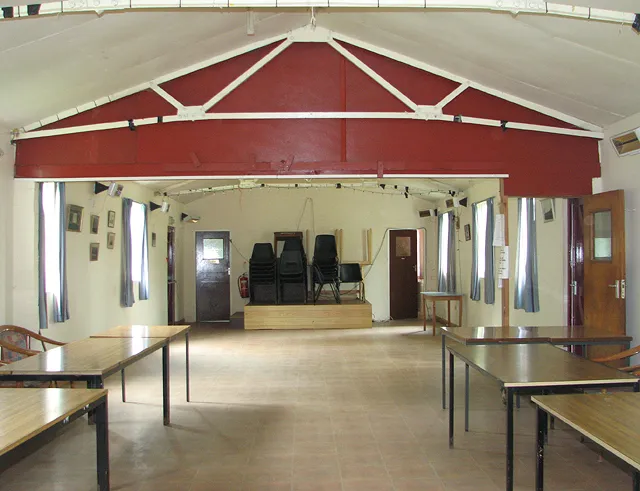
Photo: Evelyn Simak , CC BY-SA 2.0, via Wikimedia Commons
There is a particular smell to a village hall ten minutes before doors open. It is part floor polish, part urn pre-heat, part faint whiff of a Christmas fair from 2019 that has never quite left the curtains. Nobody puts it on a tourism poster. And yet, after a fortnight spent pottering around three local halls, I have become fiercely fond of it.
My argument is simple: a Saturday night panto in a hall with a squeaky stage and a raffle that runs long is often more alive than a city arena where you pay nine pounds for a paper cup of something beige. The arena has better lights. The hall has better stakes.
Three halls, one urn
Hall number one sits behind a church, down a lane that looks like it should end at a farm. The booking secretary, Margaret, showed me the cupboard of folding chairs with the pride of a sommelier. She has a system: the good chairs at the front, the ones with a slight lean at the back, and the two that should never be used but are kept “for sentimental reasons”.
The second hall had a stage the size of a large dining table and acoustics that turned every joke into a small echo. The volunteer there, Dev, told me they once had a folk band so loud that a tin of biscuits vibrated off the piano. He said it as if recalling a minor miracle.
The third hall was the poshest: proper heating, a little kitchen hatch, and a noticeboard with laminated signs about not parking on the grass. It still had the same magic. At half-time, a queue formed for tea and squash that felt more sociable than any interval I’ve had at a big venue. Nobody was queuing for the bar. They were queuing to catch up.
The strange alchemy of a small room
What makes these places work is not the building. It is the fact that everyone in the room is, in some small way, responsible for the evening. The person selling tickets is also the person who knows where the spare loo roll is. The person doing sound is also the person who drove the lead singer. The audience includes the auntie of the child in the second number. You cannot fake that.
Village hall acoustics are famously peculiar. A friend of mine once described them as “like performing inside a giant biscuit tin, but in a nice way”. You can hear the back row unwrap a sweet with alarming clarity. You can also hear a laugh ripple from the kitchen hatch to the stage, which is oddly encouraging.
The stage itself is usually a compromise: three rostra, a curtain rail that has seen better days, and a lighting rig that consists of two par cans and a lot of hope. It does not matter. In fact, the slight risk that something might wobble adds to the occasion. At the arena, the show is sealed off. At the hall, the show is happening in the same room as the tea urn. That feels honest.
A practical guide to your own village-hall night
If you are thinking of putting on a do, here is what I learned from the people who actually make it happen.
Start with the booking secretary. They are the gatekeeper, the historian and the person who knows which fuse blows when the kettle and the stage lights go on together. Be nice to them. Bring biscuits. Ask about access times, parking and whether the key is collected from a nearby house or a plant pot.
Walk the room as an audience member. Sit in the back row. Stand by the door. Check the sightlines. Find out where the draught comes from. If the heating clanks, build it into the running order like a character.
Do the boring admin early. Risk assessment, fire exits, public liability, music licensing if needed, and a sensible ticket float. It is not glamorous, but it is what separates a lovely night from a lovely night that also goes smoothly.
Treat the tea urn with respect. It is the engine of the evening. Have enough milk, enough cups and a rota so one person is not stuck at the hatch all night. A raffle is optional but recommended. So is a sign saying where the loos are, because someone will ask.
Leave the hall better than you found it. Stack chairs the way you were shown. Wipe the hatch. Put the tables back. The next person through the door is probably a volunteer too.
Why it matters
There is a lot of talk about saving local venues, and most of it focuses on big campaigns and grand buildings. Fair enough. But the village hall is where a lot of British cultural life actually happens, quietly, on a Friday night, with a box of squash and a slightly wonky poster.
It asks you to turn up, sit on a folding chair and be part of something small. In return, it gives you a night that feels handmade. I’ll take that over a corporate light show any day of the week. Especially if there’s a raffle.