Number Fourteen on the List: Life in the Allotment Waiting Room
The form took ninety seconds to fill in. Name, address, telephone number, and a box asking which facilities I would be interested in. I ticked water supply and a shed, because in my mind the allotment was already built and fully furnished and I was merely applying for a key. The woman behind the desk looked at me over her glasses and said, quite calmly, that there were one hundred and twelve people ahead of me and the average wait was somewhere between eighteen months and four years. She said it the way you would tell someone their bus has been cancelled.
I was given the number fourteen. Not number one hundred and twelve. Number fourteen. It turned out that the list has its own internal logic, involving vacancies, plot splits, and a system of seniority I still do not fully understand. Either way, I was in. I walked back up the hill feeling oddly proud, holding a piece of paper that entitled me to absolutely nothing.
That was the start of what I have come to think of as the waiting room. Not a room at all, but a genuine community of people who have signed up to grow vegetables and have been told, politely, to hold on.
Diary of a Man Without a Plot
Month one. I read about soil. I learned that I should be building compost now, which is difficult when you have no garden, only a wheelie bin and a vague sense of shame. I started a bucket on the balcony. My neighbour Maureen asked what it was for. I said compost. She said, 'In a bucket?' and took her washing in.
Month four. I met Margaret, who has had plot thirty-two since 1994 and grows rhubarb the size of a small child. She told me I was foolish to want a full plot and should ask for a half. She was right. She is always right. This will become a theme.
Month nine. A letter arrived. Not an offer of a plot. A notice that the allotment association was holding its autumn tidy-up and would I like to help. I said yes before I had finished reading, which tells you a great deal about how badly I wanted to be involved in something.
The Society of the Not-Yet-Growing
Here is what nobody tells you about an allotment waiting list. It is not a queue. It is a club.
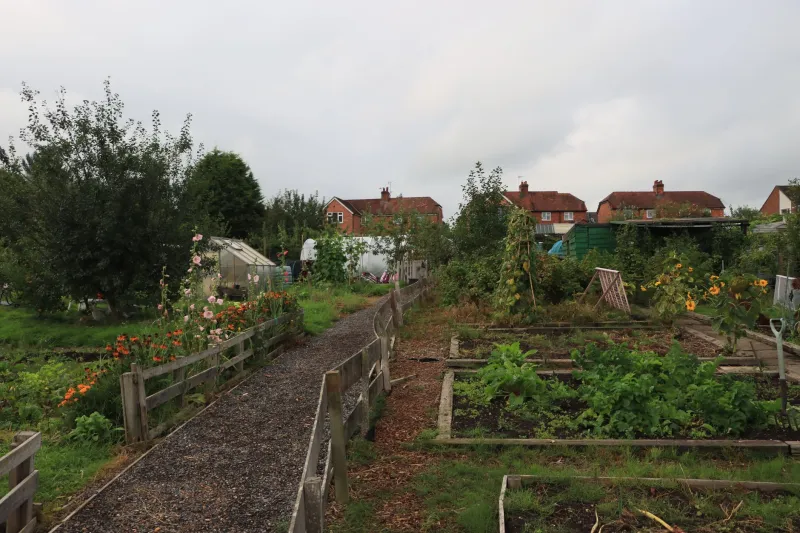
At the tidy-up I was handed a broom and put on path duty next to a man called Dev, who runs a compost heap with the discipline of a ship's captain and speaks about organic matter in a way I have only ever heard men speak about football. He told me that the wait was a good thing, because it gave you time to plan properly, to think about rotation, to consider what you actually eat. I told him I eat a lot of potatoes. He looked at me as though I had said I was planning to paint the plot magnolia.
The wait also gives you time to be useful. I found myself on a rota for the communal water butt. I helped move a shed that was not mine. I turned up on a cold Saturday in February and got given a bacon sandwich by a man called Barry, who has no plot either but has been coming for eleven years because his late wife had one and he likes the company. Nobody asks him to explain himself. That is the tone of these places. Quiet, practical, and endlessly forgiving of a man who turns up with the wrong boots.
Cucumber Diplomacy, and Other Lessons
By month fourteen I had gathered a small, hard-won education. I offer it in the spirit of a man who has never actually grown anything.
- Never turn down courgettes. You will be offered them. You will be offered them until you cannot see straight. Accept graciously, then walk away quickly.
- Learn one good face for cucumbers. You will receive cucumbers from at least three people who have grown too many and are now engaged in a quiet campaign of redistribution. This is not charity. It is diplomacy. Accept the cucumber, take the round, remember who obliged you.
- Ask Margaret before you buy anything. Tools, seeds, sheds, a full plot. She has an opinion and it will be correct.
- The correct time to arrive is 8.30am. The correct time to leave is when the tea runs out.
- Never criticise another person's weeds. Your day is coming.
- Bring two cups. Not one. Two. The second cup is how you make a friend.
Why the Wait Is the Best Bit
I do not have a plot yet. I am still number fourteen, which apparently means I am close, though I have been told that before and I am beginning to suspect that 'close' is a word the association uses to keep morale up.
But I have started to think the wait is not the inconvenience before the hobby. It is the hobby. I have met Margaret and Dev and Barry. I have learned that a compost heap has a temperature, that a full plot is too much for one person who works full time, and that a half plot is still too much for most people. I have learned that the whole enterprise is built on the exchange of surplus and the careful forgiveness of failure. Nobody at that site has ever made me feel stupid for not knowing what bolted lettuce looks like.
When I do get my key through the letterbox, I will dig it badly. My first year will be a disaster. I already know this, because Dev has told me, cheerfully, that everybody's first year is a disaster and the only thing that matters is whether you turn up again in the second one. He offered me a rhubarb crown as he said it. I said thank you. I did not say that I have no idea where I am going to put it.
That is the thing about waiting, in the end. You spend two years learning how to receive things you are not quite ready for.