Odd Numbers and Good Soap: A Saturday Behind the Tombola Table
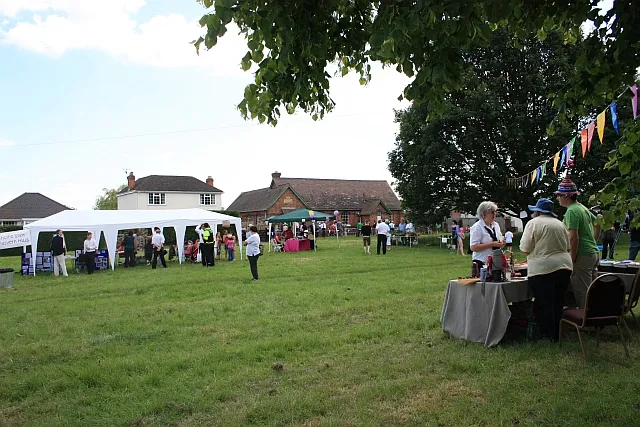
Photo: Bob Embleton, CC BY-SA 2.0, via Wikimedia Commons
There are two chairs behind the tombola table at the village fete. One is a folding chair with a cushion tied to it with baler twine. The other has one short leg and a tendency to lurch sideways whenever somebody leans over to inspect the prizes. I was given the second chair. By ten past two, I had developed a compensatory lean and a working theory about the great British village fete: the tombola is not a game of chance. It is a mirror.
This year's fete took place under a sky that could not decide between sunshine and a light drizzle, which is to say it was a proper English Saturday. There was bunting, a cake stall doing steady business, and a chap from the parish council selling raffle tickets with the quiet urgency of a man who has promised the Scout hut a new roof. I had volunteered for the tombola because I am the sort of person who says yes to things in April and regrets them in June. By the time the first punter arrived, I had arranged the prizes into what I believed was a pleasing display. This lasted approximately four minutes.
The Table of Fallen Giants
A tombola prize table is a museum of good intentions. Everything on it has been donated, which means everything on it has a story. There are the reliable classics: a tin of tomato soup, a bottle of cheap lemonade, a packet of digestive biscuits that has been in somebody's cupboard since a holiday in 2019. There is the decorative soap, still in its box, shaped like a seashell and smelling faintly of a hotel bathroom. There is a jigsaw puzzle with a picture of a lighthouse on the box and, I suspect, a missing corner piece inside. There is a bottle of sherry with dust on the shoulder, which everyone agrees is a 'good prize' but nobody actually wants to win.
Then there are the mystery bags. These are the tombola's answer to the unknown. They are usually wrapped in carrier bags from supermarkets that no longer exist, and they contain things like a single oven glove, a small notebook with the first page torn out, and a keyring from a garage in Dorset. The mystery bag is not a prize. It is a dare.
What fascinates me is how quickly the table becomes a social map. The person who donates a tin of soup is not mean. They are practical. They have looked in the cupboard, seen something they will never eat, and decided that somebody else might. The person who donates the decorative soap is a romantic. They believe that a fete should have a little glamour, even if that glamour smells of potpourri. The person who donates the sherry is either generous or clearing out a drinks cabinet, and it is not my place to ask which.
The Etiquette of Winning Twice
The tombola works like this: you buy a strip of tickets, usually for 50p or a pound, and each ticket ends in a number. If your number ends in a five or a zero, you win. The prizes are not ranked. A tin of soup and a bottle of wine sit side by side with the same hopeful energy. This is the great democratic promise of the tombola: every ticket is equal, and every prize is technically a prize.
But etiquette arrives the moment somebody wins. The first win is straightforward. There is a small ceremony of surprise, a glance at the table, and a decision. The correct response is a modest 'oh, go on then' followed by a show of indecision between the soap and the biscuits. You must not appear too pleased. You must not appear too disappointed. You must take your prize with the air of someone accepting a minor civic honour.
The second win is where things get delicate. If you win twice in a row, the table goes quiet. The people behind you shift their weight. Somewhere a child is holding a losing ticket and staring at the decorative soap. You have become a problem. The etiquette here is subtle. You must perform a small wince, offer to put something back, and then accept the second prize anyway because refusing would make everyone more uncomfortable. The phrase 'I'll swap it for the soup' is a useful escape hatch. Nobody wants the soup, but everybody respects the gesture.
I saw a woman win three times. By the third win she was laughing in a way that suggested she might never recover. She took a bottle of lemonade, a notebook, and the decorative soap, then spent the next ten minutes trying to give the soap to a small boy who had clearly set his heart on it. He refused. His mother said he was fine. The soap went home with the woman, who I suspect will regift it at Christmas with a clear conscience.
The Economy of the Jam Jar
The money side of the tombola is simple. The stall takes more than it gives, and that is the point. The fete is a machine for converting spare change into a new roof for the Scout hut, a set of new cricket nets, or whatever the parish has decided needs fixing this year. The tombola is the gentlest form of fundraising because nobody feels they are being asked for money. They are being asked for a small, affordable gamble with a biscuit at the end.
By three o'clock, the table looked like a car boot sale after a gust of wind. The good prizes had gone. The soup remained. The mystery bags had been picked over, leaving only the ones that contained a single oven glove. A child won a tin of marrowfat peas and held it aloft like a trophy. His father looked at me with the weary pride of a man who knows he will be carrying peas home in a rucksack.
I bought a ticket near the end. I won. The prize was a tin of tomato soup. I took it home, put it in the cupboard, and realised I had become exactly the sort of person I had spent the afternoon quietly judging. The tombola had got me.
That, I think, is the real lesson of the prize table. We donate what we do not need, we win what we did not expect, and we all agree to pretend that a tin of soup is a prize. For one afternoon, that agreement holds. The bunting stays up. The chair with the short leg keeps lurching. And somewhere a decorative soap is waiting for its next owner.