Five Pounds, Three Fields, One Notebook: A Car Boot Index for 2026
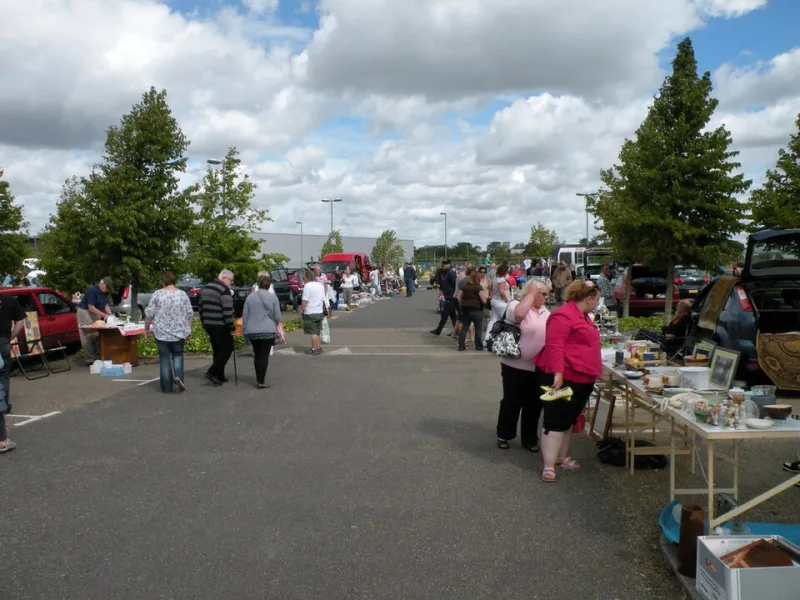
Photo: Keith Edkins , CC BY-SA 2.0, via Wikimedia Commons
I have a theory that you learn more about a country from its car boot sales than from its budget. So on the first Sunday of November — the last properly outdoor weekend of the season round here — I set off with a five-pound note, a notebook and a thermos, and spent the morning working three sales within eight miles of my own front door.
The idea wasn't to bag a bargain. It was to build a small, deeply unscientific price index of British second-hand life in 2026: what people think things are worth, what they'll actually take, and which objects the world has quietly given up on.
The rules I set myself
- One fiver. No card, no cashpoint top-up, no borrowing off the man selling doughnuts out of a van.
- Every purchase logged: asking price, price paid, one-line verdict.
- No haggling on the first item at each site, so nobody could accuse me of playing favourites.
- Tea money kept in a separate pocket, because I am eccentric, not reckless.
The five-pound note is a useful unit of measurement. It's roughly the price of a decent coffee and a pastry now, which meant every stall became an instant comparison: would I rather have this, or breakfast?
Field one: the recreation ground, 7.40am
Frost on the grass, breath in the air, and the particular smell of a Transit van boot lid going up. Sellers here pay eight pounds a pitch and arrive in the dark to get the corner spots, which tells you something about margins before you've spoken to anyone.
The first thing I saw was a folding camping table with a wobbly leg and a label reading £4. The second thing I saw was a man selling three strimmers, none of which he could start, for a tenner each. Nobody was buying.
What was moving: children's bikes, Wellington boots, and mugs. Always mugs. I bought a stack of four matching Denby seconds for £2.50 — asked £3, and I broke my own no-haggling rule immediately, which I'd like to think says something about my character.
Ray, sixty-odd, ex-plumber, was selling tools he'd owned for forty years and had, by his own admission, sold twice already. "People want cheap, but they don't want heavy," he told me. "Anything I've got to explain, I've got to knock a pound off." He sold a set of chisels for £3 and a spirit level for a pound, and seemed pleased with both.
Field two: the cattle market car park, 9.15am
Hardstanding, so better goods and harder prices. This is where the house-clearers come — the ones doing it out of necessity rather than a Sunday hobby — and the atmosphere is different. Less banter, more arithmetic.
A woman in her fifties was emptying her late father's shed across two tables. Hand tools, a Bush radio, a set of Pyrex in the orange pattern that everyone's nana had. "I priced it all at a pound because I couldn't face deciding," she said. "Turns out a pound's about right for most of a life."
That's the line of the morning, and I wrote it down as soon as she turned away.
Here, a fiver got you a working food mixer or a decent coat. A young couple were loading a cot and a high chair into a hatchback — £30 the pair, and they'd clearly done the sums before they arrived. "New, that's two hundred and something," the dad said. "And it's going to get sicked on either way."
Field three: the school playground, 10.50am
End of the season, and the mood is giveaway. Tables are being packed up half-loaded. This is the field of bundles: a whole washing-up bowl of Lego for £3, six books for a pound, "fill a bag for two quid".
I watched a boy of about nine negotiate the sale of his own toys with a seriousness I've not seen in any boardroom. He wanted £2 for a remote-control car, was offered 50p, and settled at £1 with a handshake. His mother looked like she might cry and also like she'd been training for this moment for years.
The 2026 car boot index
What a five-pound note bought, on the day, across three fields:
| Item | Asking | Paid |
|---|---|---|
| Four Denby mugs | £3.00 | £2.50 |
| Hardback novel, 2019 | £1.50 | £1.00 |
| Garden trowel, rusty but honest | £2.00 | £1.00 |
| Bag of Lego | £4.00 | £3.00 |
| Bush radio (untested) | £5.00 | — |
| Bread maker, 2014 vintage | £6.00 | — |
| Brass door knocker | £8.00 | — |
Total spent: £4.70. Total saved versus new: unknowable, but the mugs alone would have been £30 in a shop, and I'd have felt quite smug about it.
What the notebook says between the lines
Three things kept coming up.
First, the £1 floor. Nobody prices below a pound, even for things that are clearly free to a good home, because a pound is the difference between a sale and a conversation.
Second, the repair economy is real and it is happening in fields. I counted eleven people buying something described as "needs a bit of work". A kettle, a strimmer, two bikes, a wooden ladder. Not landfill — raw material.
Third, everyone was doing the same maths out loud. New prices came up in nearly every conversation I overheard. Not as complaint, more as background music. The second-hand market has stopped being a hobby for people with time and become a routine for people with bills, and the two groups now share the same muddy field and get on fine.
The things I didn't buy
A wedding album, £2, which felt like an act of trespass even to open. A bread maker, £6, on the grounds that I have owned three and used none. And a brass door knocker shaped like a fox, £8, which is the only genuine regret of the morning.
Five pounds, well spent
I came home with a bag of Lego, four mugs, a trowel and a paperback, and I'd talked to about twenty people I'd never met. There's a version of the cost-of-living conversation that happens in spreadsheets and news bulletins, and there's another version that happens at 7.40am with frost on the ground and a man named Ray explaining why nobody wants a heavy tool any more.
The second one is warmer, and honestly, it's more useful. The fiver's gone, mind. Next season I'm taking a tenner and a proper list.