Forty Minutes Before the Lorry: A Pavement Study of Bin Day Etiquette
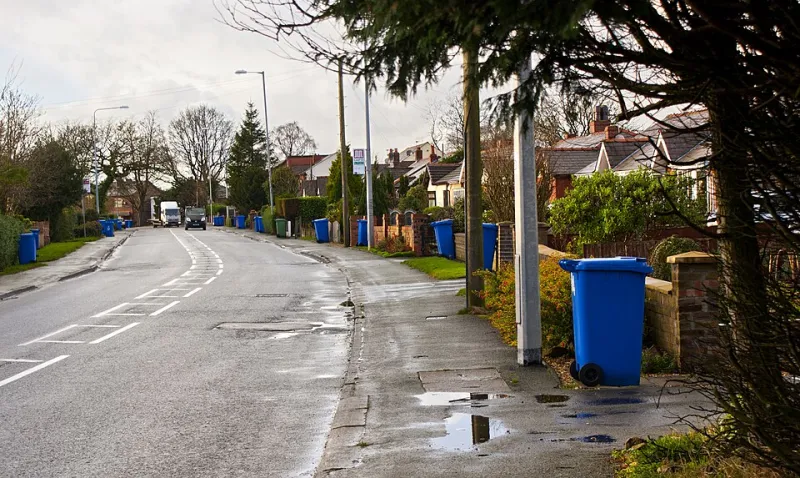
Photo: Ian Greig , CC BY-SA 2.0, via Wikimedia Commons
There is a particular sound that arrives on a Tuesday morning in a village like ours: not birdsong, not the milk float, but the low, self-important rumble of a lorry that has clearly been told it is the main event. By the time it reaches the top of the lane, the pavement has already told its story. Some bins stand to attention. Some lean. One has been dressed in a high-vis jacket by a child with a sense of theatre. This is bin day, and it is never just about rubbish.
I have spent an unreasonable amount of time watching this ritual from my kitchen window, mug in hand, and I have come to the conclusion that the wheelie bin is the most honest piece of civic furniture we own. It reveals who we are before we have had a chance to compose our faces. It shows whether we are planners or panickers, whether we trust the forecast, and whether we are the sort of household that writes a name on the side in marker pen. Ours says TARGETT in slightly wonky capitals, because I did it in a hurry in 2019 and have never quite recovered from the shame of the second T.
The Night-Before People
You can divide any street into two camps: those who put the bin out the night before, and those who wait until the lorry is audible. The night-before people are not simply organised. They are making a statement. Their bins are out by seven, handles turned neatly towards the house, lids pressed down like a well-made bed. They have checked the collection calendar. They know it is recycling week without consulting the app. They are the same people who bring a spare pen to the village hall and a folding chair to the fireworks.
I admire them, but I do not entirely trust them. There is something faintly smug about a bin that has been sitting on the pavement since Monday evening, dew on the lid, daring the foxes to try it. The rest of us are the forty-minutes-before-the-lorry people. We are not disorganised; we are simply in denial about the passage of time. We hear the rumble, say a word that is not suitable for the parish magazine, and sprint out in slippers with a bag of yogurt pots. It is not dignified, but it is honest.
Handles, Hinges and the Unwritten Code
Now, the handles. Nobody has ever written down the rule, but everybody knows it. The bin should face the road, handles towards the house, so the collection crew can wheel it and tip it without performing a small dance. Get it wrong and you will feel the disapproval from across the street. Not a word will be said. Just a neighbour adjusting their own bin with exaggerated care, as if to say, this is how we do things here.
There is also the question of spacing. Too close together and the lorry's arm cannot reach; too far apart and you look like you are avoiding someone. The correct distance is roughly one bin's width plus a polite pause. It is the same distance you leave at a village fete when you want to look approachable but not available for a long conversation about the hedge.
And then there is the lid. A lid that will not close is a public confession. It says: I have been to the tip, I have failed, and now I am asking the entire street to bear witness. You can buy a bin strap for £3.99, but somehow that feels like admitting defeat. Better to balance an old brick on top and hope the crew are in a forgiving mood.
The Runaway Lid and Other Small Diplomacies
Last month, a gust of wind took next door's lid clean down the pavement and into the road. I watched it go with the helpless horror of a man who knows he is about to be involved. Retrieving a neighbour's runaway lid is a delicate operation. You must not look too pleased about it. You must not knock on the door with a triumphant little smile. You simply place it back on the bin, give it a pat, and retreat indoors before anyone can thank you properly.
There is a whole grammar to these exchanges. Holding someone's bin back from the kerb while they reverse out of the drive. Turning a neighbour's bin around because they put it out handles-to-the-road and you know they will be mortified when they realise. Lifting a fallen bag of recycling with a stick, because you are not a saint and nobody expects you to touch someone else's cat-food tins. These are the small diplomacies of pavement life, and they matter more than we admit.
What the Pavement Knows
I have come to think of bin day as a weekly audit of the neighbourhood. Not of its rubbish, but of its habits. The house that always has three bags of recycling and one small bin of general waste is clearly trying. The house that puts out a single carrier bag and a guilty wave is clearly not. The house that has a bin so clean you could eat your tea off it is either a retired couple with standards or a front for something.
And somewhere in all this, there is a genuinely serious point. We live in a time when civic life is often conducted through apps and email and the occasional passive-aggressive post in the village WhatsApp group. Bin day is different. It is physical. It is shared. It requires you to step outside, look at your neighbours, and participate in something that nobody organised but everybody understands. It is the clumsiest, most ordinary form of community there is, and I would not swap it for anything.
So tomorrow morning, when the lorry comes rumbling up the lane, I will be at the window with my tea, watching the great wheelie-bin waltz begin. I will see the night-before people pretending not to gloat. I will see the forty-minutes-before people sprinting in slippers. And I will quietly check that my handles are facing the right way, because I am not a monster.