Raised Tarmac, Lowered Tempers: A Week on the New Speed Cushions
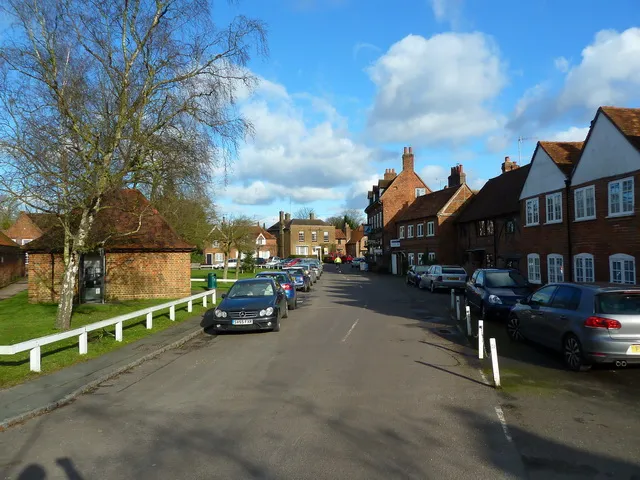
Photo: Alexander P Kapp , CC BY-SA 2.0, via Wikimedia Commons
On a damp Monday morning in November 2026, the parish's latest experiment arrived not with a ribbon but with a lorry, a bloke in a hi-vis jacket and a smell of hot tar that hung around the green like a guilty secret. By Tuesday, the speed cushions were in. By Wednesday, everyone had an opinion.
I live on what I have come to call the wrong side of the new layout — the side where the cushion sits just far enough from the kerb that you cannot quite ignore it, but close enough that you spend a second deciding whether to straddle it or take it like a grown-up. That second, multiplied by every driver, cyclist, dog-walker and delivery van in the parish, is where the week's entertainment has come from.
The First Casualty Is the Suspension
The first thing you notice is not the speed. It is the noise. A car that arrives at 28 mph leaves with a thud and a rattle that says more about the state of its suspension than any MOT certificate ever could. The second thing you notice is the brake lights. They flick on, then off, then on again, like a nervous indicator that has forgotten its purpose.
By Thursday I had developed a small, unscientific taxonomy. There is the Straddler, who lines the car up so the cushion passes underneath like a sleeping policeman who has been told to lie down. There is the Braker, who slows to 12 mph, peers over the wheel and treats the cushion as a personal affront. And there is the Local, who knows the layout so well that they approach at an angle, clipping the edge with the confidence of someone who has done this every day since the tar was warm.
The 20 mph signs, meanwhile, are doing what signs do best: existing. They are round, red-rimmed and entirely mute. Nobody has yet been observed reading one aloud, though one man in a Nissan Micra did point at it with a look that suggested he was about to write a letter.
The Dog Walkers' Truce
The unexpected winners are the dog walkers. The pavement by the old telephone box has always been a tight squeeze, but the new cushions have slowed the traffic enough that crossing to the green no longer feels like a scene from a disaster film. On Wednesday I watched a woman with a spaniel and a pushchair make it across in one go, without the usual semaphore of apology and half-run. She looked almost disappointed. There was nothing left to complain about.
Cyclists are more divided. The confident ones take the cushion square-on and rise out of the saddle like they are cresting an Alpine pass. The less confident ones veer towards the gutter, which is exactly where the drain is, which is exactly where the puddle is. I have seen two near-misses and one very polite exchange of hand gestures that I am choosing to interpret as a wave.
The Van That Would Not Be Rushed
Then there is the delivery van. You know the one. It has a dent in the back door, a clipboard on the dash and a driver who has been doing this round since before the parish last tried a chicane in 2019. On Friday he arrived at 8.12, slowed to a crawl, looked at the cushion, looked at me, looked back at the cushion, and then drove over it at an angle so precise it could have been measured. He did not speed up afterwards. He did not need to. The whole street had already learned its lesson.
What struck me most was not the driving. It was the etiquette. People who have never spoken to each other are now nodding at the cushion. There is a shared understanding that we are all in this together, and that the person in front is probably going to brake, and that the person behind is probably going to sigh. The village WhatsApp group has already produced three separate theories about why the cushions are the wrong shape, two photographs of a cracked kerb and one message that simply says: 'Twenty's plenty, apparently.'
What the Signs Actually Say
I am not against the cushions. I am against the way we talk about them. The 20 mph limit is a sensible ambition, and the cushions are a nudge in the right direction. But a nudge only works if the road layout makes sense. The cushion outside the bakery is fine. The one by the bus stop is a puzzle, because the bus cannot straddle it and the driver cannot avoid it, so every service now arrives with a small earthquake and a look of quiet resignation.
That is the thing about traffic calming: it calms the traffic, but it also calms the conversation. We have gone from 'something must be done' to 'well, it has been done, and now the suspension needs doing.' The parish council has promised a review in the spring. I have promised to keep a notebook. Neither of us has promised to stop drinking tea.
The Tea-Round Verdict
By Sunday evening, the cushions had settled into the landscape. The tar smell had gone, the brake lights had become less frequent, and the dog walkers had resumed their usual pace. The van still comes through at 8.12. The Micra still points at the sign. The WhatsApp group has moved on to a debate about wheelie bins.
Did it work? Ask me in six months. For now, the village is driving a little slower, walking a little easier and complaining a little louder. That is not nothing. In fact, for a parish that runs on tea and mild indignation, it might be the most successful piece of traffic calming we have had in years.